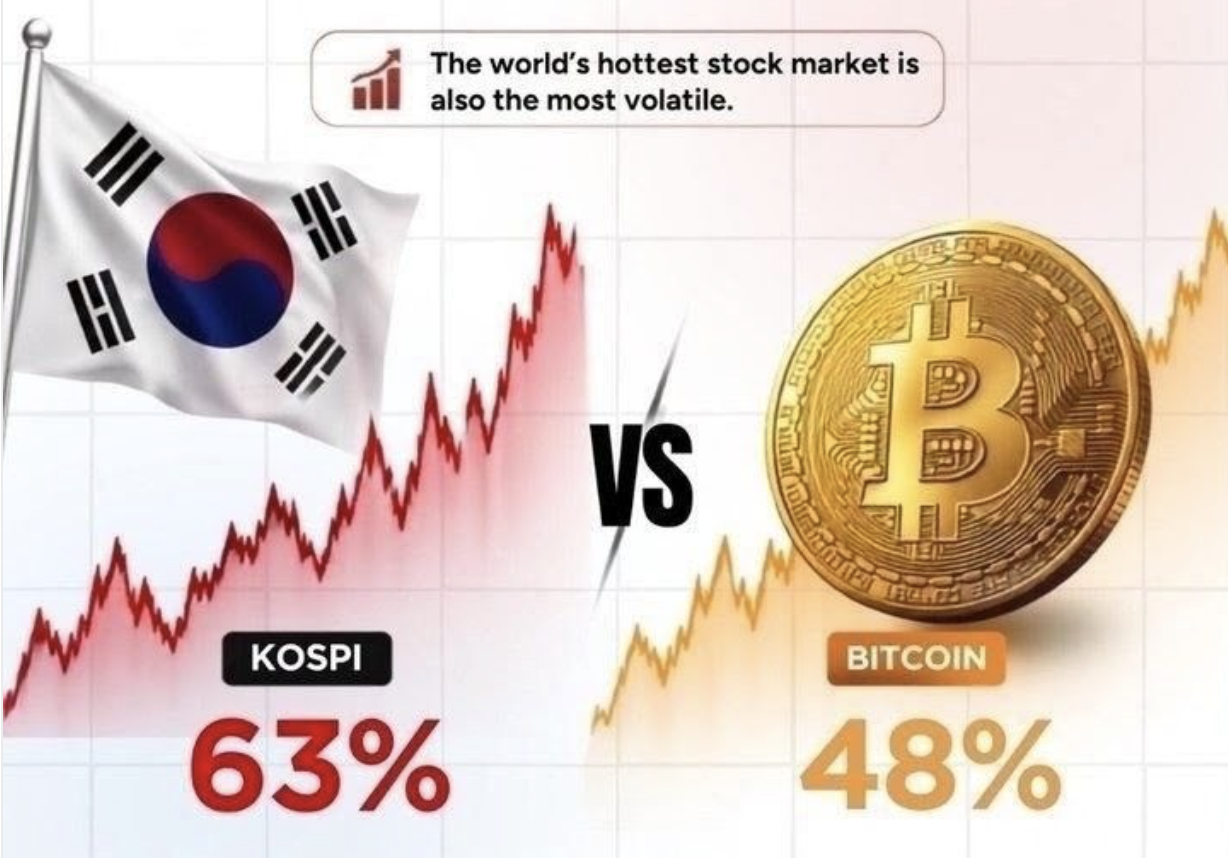
The Anatomy of an AI Bubble: South Korea Is the Warning Wall Street Doesn’t Want to See. #SouthKorea has produced a warning that investors should not ignore: the #AI boom is becoming a leverage boom. The #KOSPI rose 122.7% from the beginning of the year to its June 19 record of 9,385.59. Then the floor disappeared. The index plunged 22.19% in July. On July 31, it did the opposite: it exploded 17.91% in a single day. SK hynix jumped almost 30%. Samsung Electronics surged 27%. That is not healthy price discovery. That is a market losing its anchor. By the end of July, @KOSPI volatility had reached 63%, almost twice the Nikkei 225 and, remarkably, higher than Bitcoin. The KRX | Korea Exchange has already halted trading nine times this year. There were no such suspensions in 2025 and only one in 2024. Three forces created this monster. First: Samsung Electronics and SK Hynix. Both companies are genuine beneficiaries of AI. Their memory chips are essential to the enormous data-centre buildout. But investors have taken a legitimate technological trend and priced it as though demand will grow indefinitely. The industry is effectively betting hundreds of billions of dollars that future AI profits will justify today’s capital expenditure. Second: leverage. Margin financing exceeded 38 trillion won ($25,4 млрд). Leveraged ETFs have added another accelerant. This is where markets become unstable. Leverage pushes prices higher. Higher prices attract even more investors. Then prices fall, leverage becomes forced selling, and forced selling creates another fall. Third: retail investors. Korean investors have poured more than 110 trillion won ($77 млрд) into KOSPI stocks this year. The public did not merely participate in the AI rally. And now everyone is asking whether the July collapse was the buying opportunity of the decade. Maybe. J.P. Morgan says leverage has largely been washed out. Morgan Stanley has upgraded Korean equities. Foreign investors returned aggressively on July 31. But there is a much bigger problem. The AI story can remain intact while AI stocks collapse. That is the distinction investors are missing. Technology can continue advancing. Data centres can continue multiplying. Samsung and SK Hynix can continue making money. And their shares can still fall 30%, 40% or 50%. Why? Because markets do not price technological progress; they price expectations about technological progress. South Korea is therefore not simply an opportunity. It is an experiment. It is showing what happens when a genuine technological revolution is combined with concentrated stocks, retail euphoria and leverage. The most dangerous sentence in markets is: “This time is different.” South Korea may still make a new high this year. But if the AI spending cycle eventually slows, investors will discover something brutal: The biggest bubble is not necessarily in AI. It may be in the price investors are willing to pay for AI.